Subscribe RSS

Archive for the Category "Best Of"

Slings and arrows Jan 06

There is no way Charles Kennedy can continue as Liberal Democrat party leader.

I was one of the many grassroots activists backing Charles over the last few weeks despite the anonymous briefings against him. His announcement last night was a shock, despite the rumours about his drinking in the past. I could probably accept having an ex-alcoholic as leader (assuming he stayed that way), although his repeated earlier denials of a drinking problem do not sit well with a slogan of “Freedom, Fairness, Trust“.

A parliamentary leader without MPs behind him, though, is not a leader at all. Charles has lost the support of so many MPs, including previously supportive members of the 2005 intake, that his position is untenable. If he can’t keep the best Commons performers on the front bench then he can’t possibly run an “effective opposition”. Even though the membership elects the leader, if he doesn’t have the support of his MPs, he can’t continue. Many of the MPs who signed the letter asking him to consider his position are people I like and respect. Charles as leader may have been worth one or two of his colleagues, but not 25 MPs.

Over the last few weeks, Charles has been able to say that he counted on grassroots support, but that is evaporating too. Most of my friends in the party backed him in December. I’ve spoken to many today and every one of them agrees that he cannot continue as leader.

Charles was one of the reason I joined the LibDems and has done great things for us so I’ll be sad to see him go, but go he must. There will be a leadership election, but Charles should not be a candidate.

Category: Best Of, Politics  | LibDig This!  | 10 Comments
Will’s kakuro masterclass Oct 03

Kakuro is the most recent puzzle to be described by the cliché "the latest craze in Japan is now sweeping the UK." It has similarities with sudoku as far as numbers have to be slotted into rows and columns based on which numbers occupy other squares, but there is one significant difference: kakuro does involve some maths.

Take a look at kakuro.info’s daily puzzle to see what a whole puzzle looks like.

How it works

Given a grid, the aim is to ensure that every block adds up to the number at its beginning, using the digits 1-9 a maximum of once each. The numbers in the grid below indicate that the top row must add up to 4, the second row to 7, the first column must add up to 5, the second column to 3 and the third to 4.
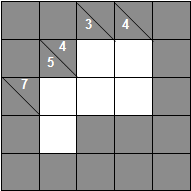
Kakuro grid

The key with kakuro is to know some of the most common patterns of numbers that add up to certain targets. For example, 3, as in the second column of the grid, can only ever be the total of two digits: 1 and 2. Just knowing this tells us that the second column has a 1 and a 2, but we don’t yet know in which order.


more…

Category: Best Of, Geeklife, Number puzzles  | Tags:  | LibDig This!  | 11 Comments
SoDooku Jul 14

Things have been getting a bit serious on the blog lately, so here’s something ridiculously geeky – in the “You wasted your lunch hour on that?” sense – to lighten the mood.

Just to show that sudokus don’t have to use numbers – any set of discrete symbols will suffice – Christopher Lee stars in a puzzle far, far away… it’s SoDooku!

3
7 8
7 5
3 9
7
6
6
4
5 1
2
6
8 1
7
2
8
9
5
4 7
6 3 7
5

Pix via Google Image Search; puzzle from Sudoku Generator – rather than the traditional method preferred by The Guardian, where, beginning at sunset, an elderly Japanese man calls out numbers at random while being beaten with a broom of bamboo, this continuing until a puzzle with only one solution has been formed which is then etched into a marble tablet, sanctified in holy water and flown to Farringdon. That sounded like too much effort.

Calling of General Election delayed Apr 04

Given that their country is in mourning, Tony Blair has decided that it would be inappropriate today to go to the Poles.


Category: Best Of, Politics  | LibDig This!  | 2 Comments
Speak your brains Mar 09

As promised (and requested, amazingly), here’s the speech I gave to LibDem conference on Sunday about the Government’s plans for control orders. Already Charles Clarke has accepted some of these criticisms and announced concessions.

This speech is especially recommended for regular readers Alan, Simon and Nick.

“No freeman shall be arrested or imprisoned or disseised or outlawed or exiled or in any way harmed. Nor will we proceed against him, or send others to do so, except according to the lawful sentence of his peers and according to the Common Law.”

Nearly eight hundred years ago, King John signed those words as part of Magna Carta. And yet it comes as no surprise – but certainly a disappointment – that the Labour Government should challenge a freedom so basic as the presumption of innocence. This Government, which would disregard trial by jury, which would issue us with a plastic card to prove we exist, is behaving true to form.

The Home Secretary has accepted a key criticism of the Prevention of Terrorism Bill. He’s conceded that judges, not ministers, should impose any instance of house arrest. But Charles Clarke wants to keep for himself the power to impose lower level “control orders” on British people whom he suspects – only suspects – may be involved in terrorist activity. These orders, he says, involve the restriction but not the deprivation of liberty.

But the powers are immense. The Home Secretary will be able to ban you from certain jobs; from contacting certain people; from using the internet; from using a telephone. You would not be able to appeal, which is for the best as, without a telephone, you could hardly call a lawyer.

Some would argue that such restrictions are necessary to protect us from terrorists. They will continue to argue this until a series of innocent coincidences conspires to make them the subjects of such an order. Then they will think again.

“Restrictions on liberty”, the Home Secretary calls his control orders. This is typical New Labour doublespeak. Any restriction on liberty is surely, by definition, a deprivation of liberty, just like house arrest. Judges, not politicians, are the people to authorise any deprivation of liberty. The survival of this principle of vital.

But les us not fall into the trap of thinking that judges are a panacea. During the Reign of Terror of the French Revolution, 20,000 people were guillotined on the orders of judges. These were kangaroo courts where the accused, deemed “enemies of the state”, were not permitted to contest their cases. Sound familiar? A judge cannot confer legitimacy unless due process is followed.

Control orders will be imposed on the basis of secret intelligence. If this is intercept evidence – tapping the phones of underworld terrorists, bugging buildings – wherever possible this should be used to prosecute in the conventional manner. If that is not possible, the accused or their lawyers must still have the opportunity to refute such secret intelligence. To explain why, I have a number, a word, and three letters: 45 minutes. WMD.

Picturing someone under house arrest – for an indefinite period and without knowledge of the evidence behind it – I am reminded of a 1960s television series called The Prisoner. Number 6 – for like Belmarsh detainee G we know him by a single character – is held in an idyllic village. His captors interrogate him, but won’t tell him why he is there. And, like your home if under house arrest, the Village has no metal bars, no cells, so it is obviously nothing like a prison.

“House arrest” – what other words does that term conjure up? Burma. North Korea. Zimbabwe. It’s a misleading term. It doesn’t mean “home arrest”. The home of most detainees would not be suitable. The accused would be locked up in a different building, separated from their families, with a permanent security presence. But it is obviously nothing like a prison.

As much as possible should be done to enable prosecution of suspected terrorists. A new offence of “acts preparatory to terrorism” should be introduced. This was proposed in Parliament and Labour rejected it. Their reason? Because it would take too long to draft. That is their commitment to producing sensible legislation.

But we do face a twin dilemma: securing our lives and our country while securing our fundamental freedoms. The Government doesn’t believe in freedoms; they prefer “rights and responsibilities”. Our responsibility is to do nothing that might create even the suspicion of being a terrorist, and the Government’s right is to deprive us of basic liberties if we do.

So LibDems in Parliament to the rescue. While the Government attempts to cast a web of fear across the country, telling us that Al-Qaeda’s deadly assassins will get us in the night, we are relying on the enlightenment of our parliamentarians to fix this bill. Al-Qaeda hate that we live in a free society, but apparently so does the Government. By taking fundamental principles to the edge of destruction, the Government is helping these terrorists in undermining our way of life. We can defeat terrorism and safeguard our liberties: by investing in the police and the security services, and by ensuring that judicial due process is at the heart of the Prevention of Terrorism Bill.

We’ve come full circle. LibDem MPs and Lords are tasked with the role of the 13th century barons against King John, to ensure a fair and democratic society. We must hope they succeed.